 How-to
How to Tell Fake Pokémon Cards in 2026
Last Updated: November 19, 2026
Quick Summary
To spot fake pokemon cards, check print sharpness, card back border alignment, texture, and holofoil movement, since fakes usually fail on printing rather than artwork. A single odd detail means little, but several small mismatches on the same card are a strong reason for concern. Compare the suspect card side by side with a verified genuine card from the same set and era.
- Genuine cards are printed at high resolution, so text edges stay crisp and colors stay clean.
- Hold the card up and compare the blue border width on all four sides for evenness.
- Tilt the card under a lamp and watch whether the holofoil shifts smoothly and looks layered.
- Never bend, scratch, or apply liquid to a card to test it.
- Ask sellers for a short video tilting the card under a lamp, since motion exposes flat foil.
Table of Contents
- Fake Pokémon Cards vs. Real Cards: What Actually Differs
- Print Quality, Sharpness, and Color Saturation
- Card Back, Border Alignment, and the Blue Swirl
- A Safe, Non-Destructive Inspection Workflow
- Text, Font, and Symbol Checks: Card Name, HP, and Energy Symbols
- Texture, Holofoil, and Raised or Etched Details
- How to Tell Fake Pokémon Cards Online: Photos, Listings, and Seller Reputation
- Pokémon Card Real or Fake Scanner App: What It Can and Cannot Do
- How to Spot Fake Pokémon Packs and Resealed Sealed Product
- Verifying Graded Cards, Slabs, and Set-Specific Differences
- Frequently Asked Questions
Fake Pokémon Cards vs. Real Cards: What Actually Differs
Fake Pokemon cards have become harder to spot, and the gap between real and fake narrows every year. Learning how to tell fake Pokémon cards in 2026 starts with one fact: fakes usually fail on printing, not artwork.
A counterfeit card is a copy made to imitate an authentic card, usually printed on cheaper stock with scanned artwork. The tells show up in sharpness, color, texture, and the card back.
Most guides treat every flaw as proof, but real cards have print variation too. The trick is knowing which signs cluster together.
A single odd detail means little, but several small mismatches on the same card are a strong reason for concern.
Print Quality, Sharpness, and Color Saturation
Print quality is one of the quickest checks available to a collector. Genuine cards are printed at high resolution, so text edges stay crisp and colors stay clean. Fakes are usually scanned and reprinted, which softens everything.
Look for these print problems:
- Fuzzy or jagged edges on letters and numbers
- Colors that look washed out, muddy, or too dark
- Ink that bleeds slightly outside the text
- A dot pattern visible under a magnifier where the original looks smooth
Fake Pokémon cards can push reds and yellows too hard, or look flat and grayish. Compare against a verified reference image of the same card from the same set, not a different printing.
One limitation: phone cameras and screen settings distort color, so a card that looks slightly off in a photo proves nothing. Judge print sharpness in person whenever you can.
Card Back, Border Alignment, and the Blue Swirl
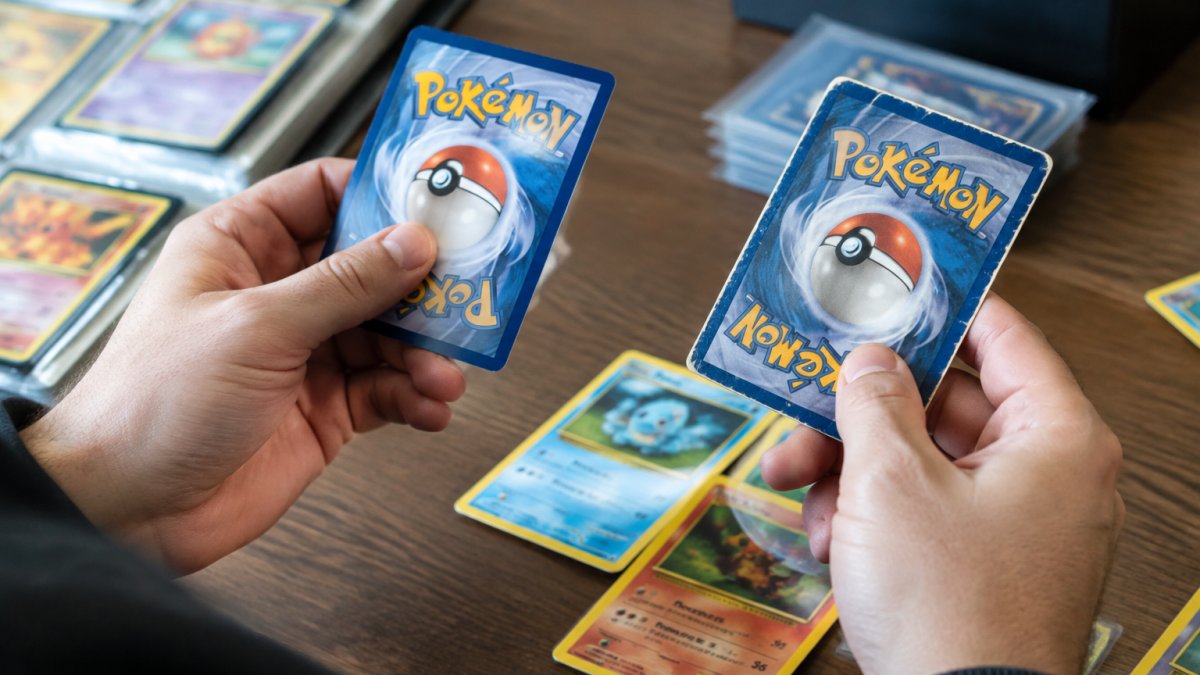
The card back is where many fake Pokemon cards give themselves away, because counterfeiters focus on the front and rush the reverse. A genuine back has a deep blue field, a clean Poké Ball design, and a consistent border.
Check border alignment first. Hold the card up and compare the blue border width on all four sides. Real cards are cut within tight tolerances, so the border looks even; a fake often shows a lopsided border or one noticeably thicker edge.
Then look at the blue swirl pattern and the fine linework inside the Poké Ball. On a genuine card these lines are sharp and continuous. On a fake they blur, break, or print with visible pixelation.
Watch out: border width varies slightly by era and print run, so a thin border is not proof on its own. Pair this check with print-quality and texture checks before you decide.
A Safe, Non-Destructive Inspection Workflow
You can inspect a card thoroughly without damaging it, and you should never test a card you might return. Work in this order:
- Start with the back. Check border evenness and the blue swirl under bright, diffused light.
- Move to the front print. Look at text edges, energy symbols, and color saturation.
- Tilt the card under a lamp. Watch how the holofoil shifts and whether texture catches the light.
- Run a light test. Hold a bright flashlight behind the card in a dark room and compare the glow to a known real card.
- Check the dimensions and feel. Measure thickness and compare flex with a verified copy.
- Compare side by side. Place the suspect card next to a known genuine card from the same set.
Keep your hands clean and handle cards by the edges. Never bend, scratch, or apply liquid to a card to "test" it. If you bought it online and suspect it's fake, stop handling it and photograph everything first.
The Flashlight and Light Test Without Damaging the Card
The light test checks the card's core. Hold the card a few inches in front of a bright flashlight in a dark room. A genuine card blocks most light, and any glow looks even and dull. Many fakes use a bright white core and glow strongly, or show a blotchy, uneven pass-through.
This test is a clue, not a verdict, since some real cards pass more light depending on era and stock. Use it alongside print and texture checks, and never press the light directly against the surface.
Text, Font, and Symbol Checks: Card Name, HP, and Energy Symbols
Text is where careful counterfeiters slip. Zoom in on the card name, the HP number, and the attack text. Genuine lettering is consistent in weight and spacing, with clean curves.
Run through this list:
- Card name: spelling errors, odd letter shapes, or spacing that looks cramped
- HP: the number should match the card's official listing exactly
- Attack text: missing words, wrong punctuation, or text that runs too close to the border
- Energy symbols: blurry edges, wrong colors, or a symbol that looks slightly off-center
- Set symbol and collector number: these must match the card's set and rarity
Cross-check the card name, HP, set symbol, and collector number against a verified reference image. A card that claims to be from one set but carries another set's symbol is a red flag, no magnifier needed.
Texture, Holofoil, and Raised or Etched Details
Texture is the hardest thing for a counterfeiter to copy, and the check most buyers skip. Modern genuine cards often carry a fine surface texture, and many full-art and special cards have raised or etched details you can feel with a fingertip.
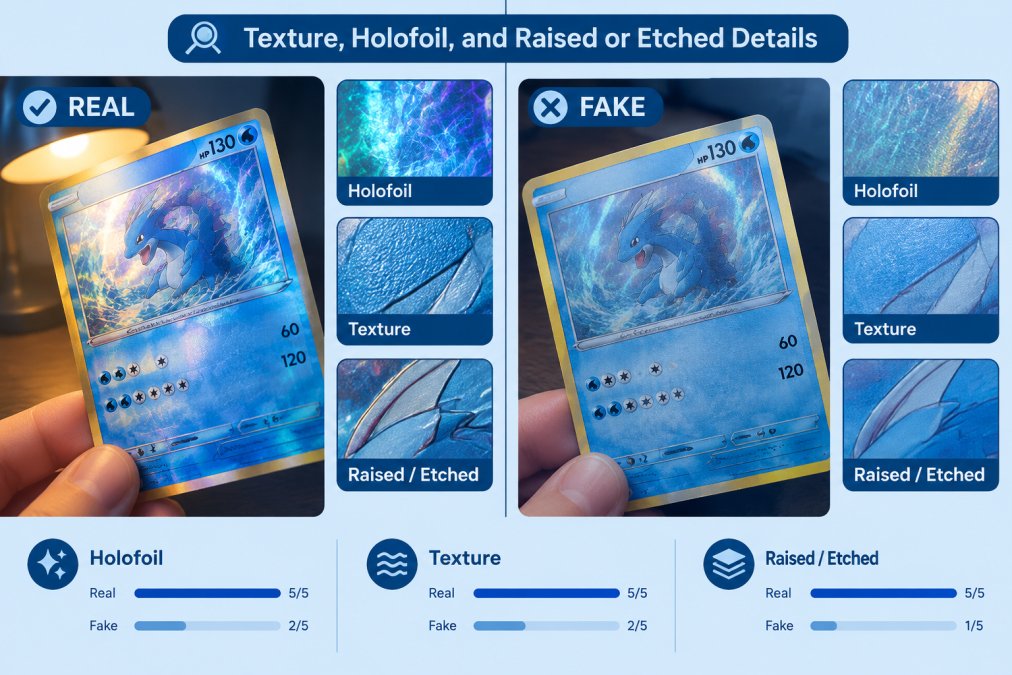
Tilt the card slowly under a lamp and watch the holofoil. On a genuine card the pattern shifts smoothly and the shine looks layered.
Feel the surface gently. Raised texture on a real card is subtle but present. A fake usually feels uniformly smooth or slightly gritty, with no real depth.
Watch out: texture varies by set and era, and older cards may have no texture at all, so a smooth feel alone does not mark a card as fake. Match your expectations to the card's set.
How to Tell Fake Pokémon Cards Online: Photos, Listings, and Seller Reputation
Buying online means judging photos, and photos hide a lot. When you are working out how to tell fake Pokémon cards online, treat the listing itself as evidence and build a request protocol before you pay.
Start with the seller. A long track record, clear return terms, and past buyer feedback carry real weight. Walk away from stock photos only, prices far below market, and pressure to pay outside a protected platform.
Then read the photos closely:
- Are the images sharp enough to show text edges and holo pattern?
- Do the same cards appear in multiple listings with different backgrounds?
- Does the seller show the card back at all?
- Is the lighting consistent, or does one photo look edited to hide color?
If the seller will not send a close-up of the card back and a tilted shot of the foil, that is your answer.
Ask for a specific photo set. Request a straight-on front shot in daylight, a straight-on back shot, close-ups of the card name and HP and of the set symbol and collector number, and a short video tilting the card under a lamp.
Separate what photos can prove from what they cannot. Photos can rule a card out: wrong text, wrong set symbol, an obviously flat holo pattern, or a back that does not match the front. Photos rarely rule a card in.
Photo-Based Checks and Image Limitations
A still image flattens the two things counterfeiters struggle with most: texture and foil movement. Ask for a short video that tilts the card under a light. Motion exposes flat foil and dull texture better than any still image, and it is much harder to fake than a single photo.
Watch out: a seller who sends only edited or heavily filtered images, or who refuses a video, is a bigger risk than a seller with slightly blurry but honest photos.
Preserve evidence before you confront anyone. If you suspect a card is fake after it arrives, stop handling it, photograph the front, back, edges, and any packaging, and save the listing text, seller messages, and payment record. Marketplaces and payment providers commonly ask for this documentation when you open a dispute.
Know when to walk away. A price far below market, a seller who pushes for payment outside a protected platform, or a listing that will not show the card back are all reasons to skip the purchase. The cheapest card online is rarely the safest one.
Pokémon Card Real or Fake Scanner App: What It Can and Cannot Do
A Pokémon card real or fake scanner app is a useful first filter, not a final verdict. These apps compare an image of your card against reference data and flag obvious mismatches. They work best as a quick screen before you do the hands-on checks.
What they can do:
- Catch crude fakes with wrong text, colors, or layout
- Confirm a card's set, name, and collector number
- Give you a fast second opinion on a suspicious listing
What they cannot do:
- Judge texture, thickness, or card stock
- Detect a high-quality fake printed from a clean scan
- Replace a side-by-side comparison with a verified card
Treat app results as one data point. A "real" result on a well-made fake is common, and a "fake" flag on a worn real card happens too.
How to Spot Fake Pokémon Packs and Resealed Sealed Product
Sealed product is its own trap. Crimped edges, glue residue, and a loose or re-glued flap are the classic signs of a resealed pack or box. Run a finger along the crimp and look for uneven teeth, double crimps, or glue shine.
For booster packs and boxes, check:
- Wrapper seams for wrinkles, glue, or a crimp that looks pressed twice
- Weight and feel against a known sealed pack
- Box seals for lifted tape, torn shrink wrap, or a re-glued flap
- The set symbol and artwork against official product images
Buy sealed product from sellers with a clear return policy, and open expensive boxes on camera. That recording is your evidence if something's wrong.
Verifying Graded Cards, Slabs, and Set-Specific Differences
A graded card is only as trustworthy as its slab and label, and a slab is not a guarantee.
Start with the label, then work outward to the case and the card.
1. Run the certification number. Many grading companies publish a public lookup where you can enter the certification number printed on the label.
2. Compare the label to the card. Check that the name, set symbol, collector number, and grade on the label match the card inside.
**3.
4. Check the card inside against the slab's claims. Even in a real slab, confirm the card matches the label's set and era.
5. Know the limits of a slab. A slab confirms only what the grading company observed at the time of grading.
Set-specific differences matter here too.
| Check | Real Card | Fake Card |
|---|---|---|
| Print sharpness | Crisp text edges | Fuzzy or jagged letters |
| Color | Clean, even saturation | Washed out or oversaturated |
| Card back | Even border, sharp blue swirl | Lopsided border, blurry swirl |
| Texture | Fine surface, raised details | Flat or uniformly smooth |
| Holofoil | Shifts smoothly, layered | Flat, printed on top |
| Light test | Blocks most light evenly | Glows strongly or blotchy |
| Text and symbols | Correct spelling, sharp symbols | Errors, blurry energy symbols |
| Slab label | Certification lookup matches card | No record, or record mismatches |
| Slab case | Clean seams, no frost or glue | Frost, glue, flex, or reseal marks |
Counterfeits keep improving, and no single check catches every fake. Stack the tells: print, back, texture, light, and text together give you a clear picture. When a card matters, buy from a source that stands behind it.
Frequently Asked Questions
How can I check whether a Pokémon card is fake without ripping it?
Skip the rip test. Instead, compare the card against a verified reference image of the exact card from the same set, then run a light test by holding it up to a lamp to check the black core layer. Look at print sharpness, border alignment, font consistency, and the card back's blue swirl. A non-destructive inspection covers nearly every counterfeit warning sign without damaging the card's value.
Can a Pokémon card real or fake scanner app actually tell if a card is fake?
A scanner app can match a card's name, set symbol, and collector number, and it flags obvious spelling errors or wrong images. It cannot judge print quality, card texture, foil treatment, or card thickness, which is where most counterfeits fail. Treat app results as a first filter only and confirm with physical checks or an in-person review before you buy.
How do I spot fake Pokémon packs and resealed booster boxes?
Check the crimped seals for wrinkles or glue residue, look for a loose or misaligned wrapper, and confirm the packaging art, font, and color match official product. Weigh the pack if you can: resealed packs often feel lighter or heavier than expected. Buy sealed product from sellers with verifiable reputation, and inspect booster boxes for a broken factory seal or inconsistent shrink wrap.
What should I check when buying Pokémon cards online?
Ask for clear, close-up photos of the front, back, and any holo areas, plus the card's edges and corners. Compare those photos to a verified reference image, check the seller's reputation and return policy, and be wary of prices far below market. Blurry or misaligned listing photos are a warning sign. For high-value singles, buy graded slabs and verify the certification number on the grader's site.